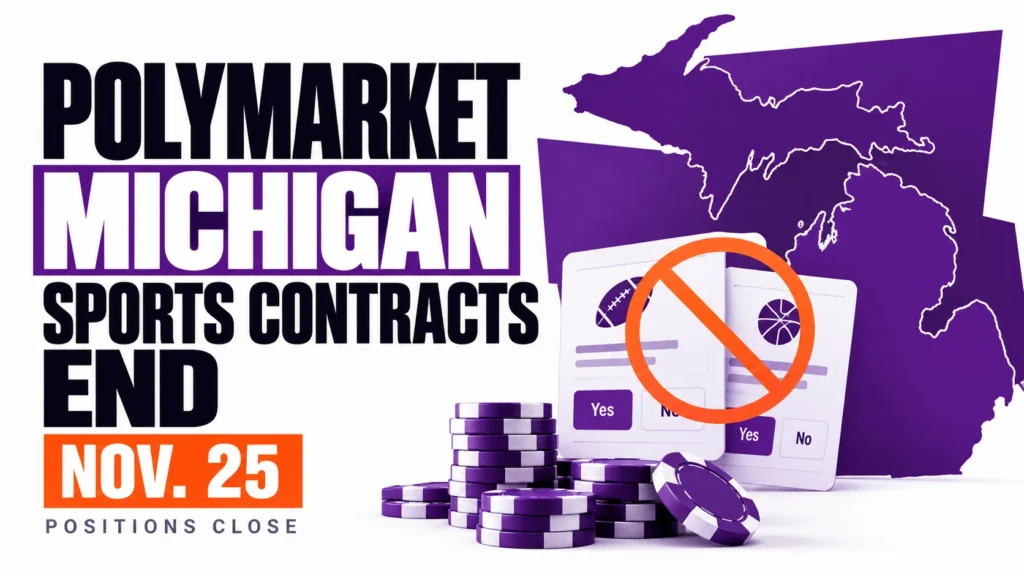
Polymarket US has agreed to stop offering sports event contracts to customers in Michigan, the latest prediction market to back down in the state.
Under a stipulation approved by the US District Court for the Western District of Michigan, QCX LLC, which trades as Polymarket US, will stop offering new sports-related contracts to Michigan customers and must close out all open positions by the end of the day Eastern time on 25 November. In return, the state has agreed not to take enforcement action while Polymarket complies, the Michigan Gaming Control Board said on 28 October.
Attorney General Dana Nessel said the state was “holding the national sports betting industry accountable to Michigan law”.
Two defeats in federal court
Polymarket started the legal fight. In March it sued Michigan officials in federal court to stop them enforcing the state’s gaming laws against it. The court refused a temporary restraining order that month and denied a preliminary injunction in June. Polymarket’s appeal is still pending at the Sixth Circuit. On 10 September the attorney general’s office told the company it would take legal action unless it stopped offering sports contracts to Michigan residents.
Every major platform has now stepped back
Michigan has dealt with each of the big prediction markets offering sports contracts. Coinbase Financial Markets and Robinhood Derivatives both agreed to stop, and the state won a preliminary injunction against KalshiEX in state court.
MGCB executive director Henry Williams said the agreement put Polymarket alongside “Kalshi, Robinhood, and Coinbase in stepping back from these unlicensed sports contracts”. “If you want to offer sports wagering to Michigan residents, you need a Michigan license,” he said.
The agreement was announced on the same day Utah filed criminal charges against Kalshi and its co-founders, and a day after the CFTC sued Utah, arguing that federal law overrides state gambling laws for event contracts. Michigan has taken a different route from Utah, settling for withdrawals rather than prosecutions, but the result for Michigan customers is the same: sports contracts on prediction markets are closing, and the state’s licensed sportsbooks and online casinos are the regulated options left. Our US regulation tracker shows where each state stands.