Crypto gamblers have had a bad autumn. In five weeks two crypto casinos lost around $7 million between them from their hot wallets, a hacking group claims to hold the customer database of one of them, a prediction market was drained for the second time this year, and Binance, the exchange many players use to fund their accounts, reported a breach it estimates at around $6.3 billion.
This guide sets out every incident that matters to crypto casino players in 2026: what happened, how much was taken, whose data was exposed and whether customers were covered. Figures for the most recent incidents are still moving, and we will update this page as they change.
Every incident at a glance
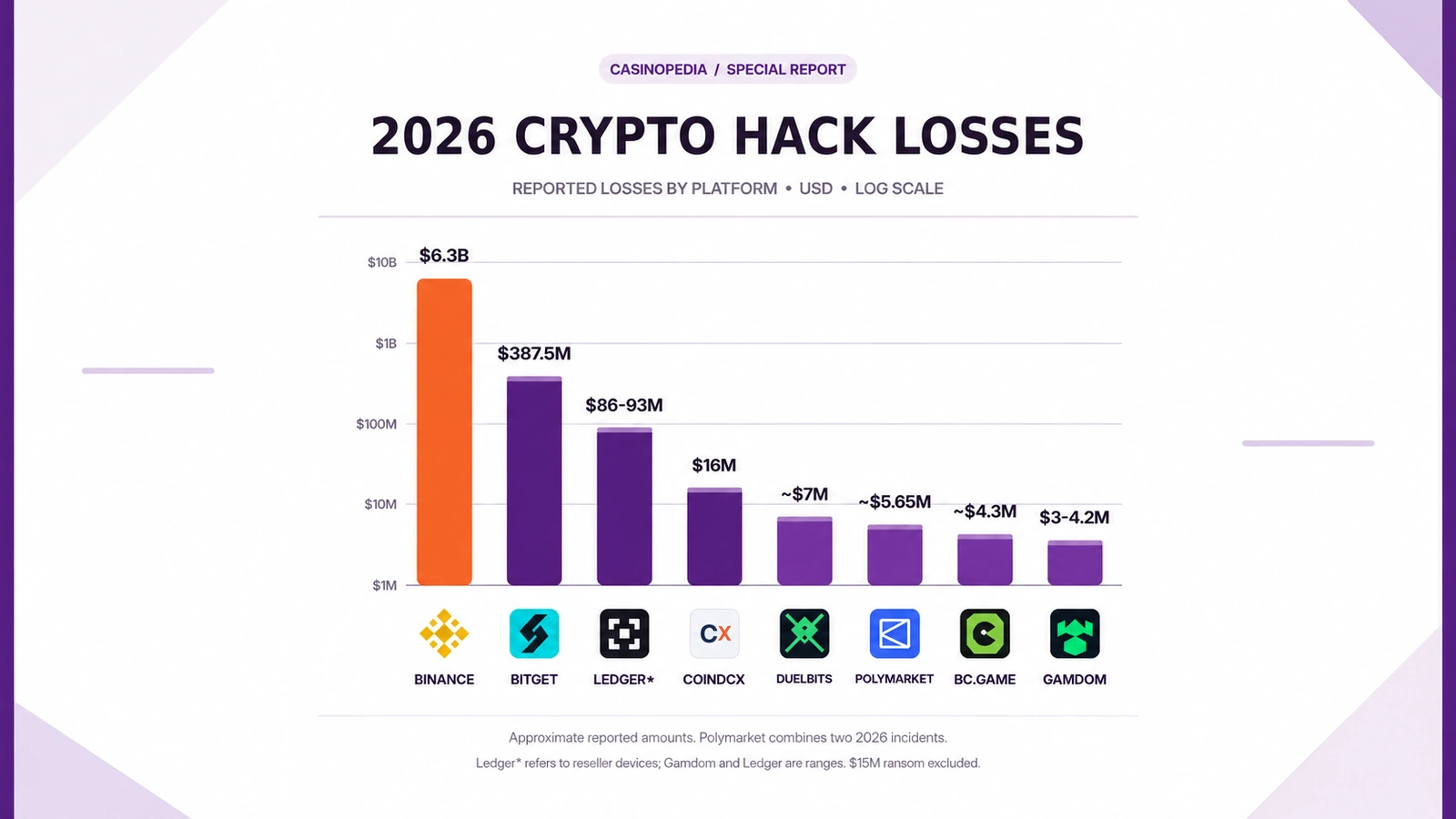
| Platform (2026) | Loss | Players covered? |
|---|---|---|
| Binance 29 Oct |
~$6.3B | Pledged |
| Polymarket 29 Oct |
~$2.65M | Promised |
| Gamdom (data) 26 Oct |
$15M ransom | Unverified |
| CoinDCX 20 Oct |
~$16M | Yes |
| Gamdom (wallets) 13 Oct |
$3M to $4.2M | Says so |
| Ledger resellers From 9 Oct |
$86M to $93M | No |
| Duelbits 24 Sep |
~$7M | Says so |
| Bitget Late Sep |
$387.5M | Yes |
| Polymarket June |
~$3M | Promised |
| BC.Game March |
~$4.3M | Unclear |
Crypto casinos
Gamdom: a wallet drain, then a ransom demand
Gamdom took its site offline on 13 October. In a statement the next morning it said a suspected disk failure had led it to find “an unauthorized connection on one of our automation servers”. Founder Felix Römer later said attackers had hit its hot wallet system and taken “just over $3m”, and that the remaining hot-wallet funds had been moved to cold storage. On-chain analyst vxdb counted about $4.2 million across several networks. Gamdom came back online on 16 October and says player funds are safe. ZachXBT has linked part of the stolen money to a laundering operation on Hyperliquid, Bankless reported.
Thirteen days later the extortion group WhiteArmor listed Gamdom on its leak site, claiming 15,420,003 accounts with 146 data fields each and demanding $15 million in bitcoin, crypto.news reported. The group says it got in through an old internal machine account with admin rights whose credentials were never changed. None of this has been independently verified, and the tracking site ransomware.live advises treating the claim with caution.
Gamdom’s position has shifted. Römer first said only a few hundred accounts were involved, then that usernames, emails and gambling history might be exposed but not identity documents. On 28 October he wrote that the account number “seems more credible”, with many spam accounts included, and that the data had been extracted in batches. We cover the claim in detail in our Gamdom data breach report.
Duelbits: about $7 million from hot wallets
Duelbits went offline on 24 September after hot wallets on Ethereum, BNB Chain, Tron and Bitcoin were drained. Co-founder Joe put the loss at about $7 million: “Still investigating exactly what happened and how,” he said, CoinDesk reported. Security firms’ on-chain counts were lower, at about $4.2 million to $4.3 million on the EVM chains and Tron plus 8.1 BTC. Duelbits said user funds were safe and relaunched on 27 September. It has not published a root cause, and it is the second time the casino has been hacked, after a loss of about $4.6 million in February 2024.
BC.Game: a third-party game exploited
In March, BC.Game said an attacker had exploited “a vulnerability in a third-party game on the platform” and taken about $4.3 million. It named the attacker’s wallet and offered a $500,000 bounty for help recovering the funds, Crypto Briefing reported. Neither the game nor its provider has been named, and no recovery has been reported.
Prediction markets
Polymarket: two third-party script attacks in one year
On 29 October a compromised analytics script on Polymarket’s international site drained traders’ accounts. Researchers traced it to DebugBear, a UK-based monitoring provider, whose script read trading keys stored in users’ browsers and moved their positions to the attacker. The attacker’s wallet held about $2.65 million, The Block reported. Polymarket says everyone affected “will be made whole”.
It was the second attack of its kind this year: a compromised third-party dependency drained around $3 million from Polymarket users in June, Decrypt reported.
The exchanges and wallets players use
Most crypto casino deposits start at an exchange or a hardware wallet, so incidents there hit players even when the casino itself is untouched.
Binance
Unauthorised withdrawals from Binance hot wallets began at about 20:05 UTC on 29 October. Binance estimates the impact at about $6.3 billion, Forbes reported, and says a compromised engineer’s laptop gave the attacker access to an internal service, with no evidence that private keys leaked. Stablecoin issuers and blockchain partners have since frozen about $3 billion, according to Binance. Blockchain analytics firm TRM Labs attributes the attack to North Korea’s Lazarus Group, crypto.news reported, though Binance has not named anyone. “Users will not bear the financial impact of this incident,” a Binance spokesperson said. Deposits have reopened, but at the time of writing withdrawals were still paused, with Binance expecting to resume them within 48 hours.
Bitget, CoinDCX and Ledger
- Bitget lost $387.5 million in late September when attackers used a breached backend system to fake transactions. Its protection fund covered users and withdrawals fully resumed on 2 October.
- CoinDCX, an Indian exchange, confirmed on 25 October that about $16 million had been drained from retired wallets, days after its chief executive called the reports a false alarm. The company says it absorbed the loss, The Block reported.
- Ledger devices sold through CryptoBilis, a Southeast Asian reseller, carried a hidden hardware implant that captured users’ recovery phrases, The Hacker News reported. Analysts estimate losses at $86 million to $93 million, Finance Magnates reported. Ledger has not confirmed a figure.
What the attacks have in common
- Hot wallets are the main target. Gamdom, Duelbits and Binance were all hit through the wallets that pay out withdrawals, across several networks at once.
- Third-party code is a back door. BC.Game lost money through a provider’s game, and Polymarket twice through outside scripts on its website.
- Theft is followed by extortion. WhiteArmor’s data claim against Gamdom came less than two weeks after the wallet drain.
- “User funds are safe” is rarely proven. Neither Gamdom nor Duelbits has published a root-cause report or proof of reserves since its breach.
What players should do now
- If you fund your casino account from Binance, you cannot move coins out until withdrawals reopen. Plan around it rather than chasing workarounds.
- Cash out casino winnings to a wallet you control, not to an exchange deposit address, until Binance confirms normal service.
- Expect phishing. Fake “refund” and “verify your account” messages follow every big hack. Never enter a seed phrase or sign a transaction from a link in an email or DM.
- If you bought a Ledger from a Southeast Asian reseller in the last 90 days, follow Ledger’s advice: do not set it up, and if you already have, move funds to a new wallet with a new recovery phrase.
- Gamdom customers should change their password, turn on two-factor authentication and treat any message mentioning Gamdom with suspicion.
- Before depositing, check a casino’s own X or Telegram channels for any pause on deposits or withdrawals. We found no crypto casino that had publicly paused either because of the Binance incident by Friday morning.
Our crypto gambling guide covers how to choose and use crypto casinos more safely.
The bigger picture
Blockchain security firm CertiK put crypto hack losses at $1.316 billion in the first half of 2026 (CertiK report) and $1.26 billion in the third quarter, with September’s $766 million the worst month of the year until now (Cointelegraph). That is roughly $2.6 billion for the first nine months. Binance’s own estimate of its breach is more than twice that figure, before the funds frozen since are taken into account.
Sources
- Forbes: Binance says $6.3 billion impacted, suspends withdrawals (30 Oct 2026)
- FinanceFeeds: Binance hack, $3 billion frozen
- crypto.news: TRM Labs links Binance hack to Lazarus
- The Block: Polymarket resumes trading after $2.65 million exploit (29 Oct 2026)
- Decrypt: Polymarket to refund users after website exploit (June 2026)
- Gamdom on X: server incident statement (14 Oct 2026)
- Felix Römer on X: hot wallet breach (14 Oct 2026)
- Felix Römer on X: account numbers and batch extraction (28 Oct 2026)
- crypto.news: WhiteArmor demands $15M from Gamdom
- ransomware.live: WhiteArmor listing for Gamdom
- Bankless: ZachXBT flags XMR laundering ring on Hyperliquid
- CoinDesk: Duelbits goes offline after $7M hot-wallet hack (24 Sep 2026)
- Unchained: Duelbits loses $7 million, says user funds are safe
- ForkLog: Duelbits resumes operations after $7M hack
- Crypto Briefing: BC.Game offers bounty after exploit (March 2026)
- BleepingComputer: Bitget resumes withdrawals after $387.5 million heist
- The Block: CoinDCX confirms $16 million loss (25 Oct 2026)
- The Hacker News: Ledger finds unauthorised hardware implant
- Finance Magnates: Ledger probes reseller supply chain
- CertiK: Hack3d H1 2026 report
- Cointelegraph: crypto hacks total $766M in September (PeckShield)